Friday, August 3, 2012

A few Museo Fotos for you! (David J. Guzman Museo, San Salvador)

We went to the national museum in San Salvador a few times this trip. There we met with many officials and made sure that the government and local archaeologists were updated on our research, as well as our future plans. The is the museum to which we accession all of our artifacts when we are excavating. The museum has a special Joya de Ceren area that is well looked after and very restricted in access.

On one of these museum trips we made sure to take time to look around again. Within the last year they opened an area that shows the religions of El Salvador and information about Maya and Pipil religions. Those photos came out a bit strange given the red lighting in the room.


Enjoy a look at just some of the artifact and remember that as archaeologists we are much more interested in the information artifacts can tell us about the past than in the objects themselves!

Statue of Dr. David J. Guzman
Called the Virgin of Tazumal (no one seems to know why the stelea is called this)
Petroglyphs found in El Salvador


A Maguay Plant Cast from Ceren
Obsidian knives and blades


Various artifacts including Jade axes (upper left) and various ceramic vessels

Pole fence cast from Ceren
Mano and Metate (top) and two mortar and pestles (bottom)


Ceramic Vessel
Jaguar Marker
Jaguar with person in the mouth


(Huehueteotl- very old deity in Mesoamerica)
New Deity descriptions from the site
Tlaloc- Mesoamerican deity of rain/water

Quetzalcoatl- Mesoamerican deity known from many sites throughout Meso.

Jaguar Head
Lithic Escentric (9 similar ones were found in Honduras at the site of Copan- Payson will be the first to do a detailed study of these this coming fall.  The skill with which these have been made continues to amaze archaeologists. It is thought was was a staff of office that might have been held by a ruler to symbolize their power. It has been interpreted as a ruler with a possible headdress and/or ancestors around this person.


Large ceramic vessel- the spikes are thought to represent a young ceiba tree (the ceiba tree is very important in Maya cosmology)
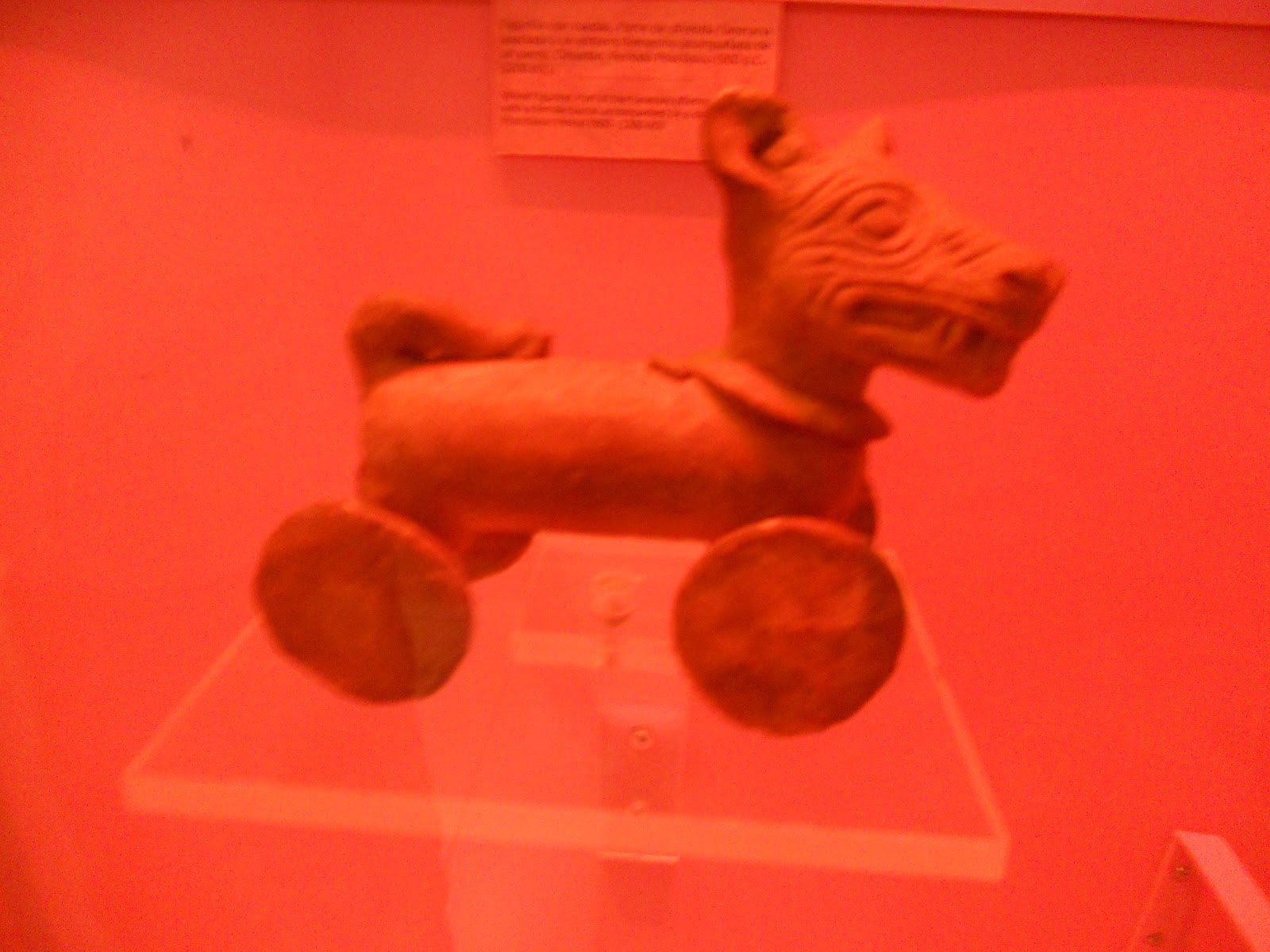
Toy with wheels- The Maya are not known to have used the wheel for anything other than toys
Ceramic Typology (Preclassic Period)
Display of a Preclassic Burial (There are very different ideas about excavating the dead from country to country. In general in Central America the display and excavation of human burials are very common and accepted by many communities- this is a much more contested practice in the United States for example)
Another Preclassic Burial Displayed


Ceramic Typology: Classic Period
Ceramic Typology: Postclassic Period
Ceramic Figurines and Molds


Jade Jewlery
Ceramic Stamps
Jade Beads and Jewelry


From the Traveling Peruvian Silver Art Exhibit

Manioc Harvest Day 3: The Power of Culture

Hi again,

Time to catch you up on the last part of our fieldwork. Manioc Harvest Day 3 was yet another interesting lesson for us gringos. We arrived at Alejandro's house early in the morning and began to record the basic information about the place where we'd planted manioc. He owns animals such as horses, goats, dogs, and chickens and the area where we were working was well fertilized (it smelled well fertilized too!)

VERY LARGE MANIOC PLANTS
Test Plot 3: Alejandro's House


One of the horses

Wild Animals of El Salvador ;)


In any event, as we began by mapping the spacing and location of each plant we noticed how large these plants were. The stalks were much bigger in diameter and there were many plants growing from single locations. Unfortunately during this time we also noticed that the initial manioc beds we had planted for our experiment had not been maintained here either! This was very disappointing since we then are not able to test exactly what we thought we were testing. 

Very Large Manioc Plants WITHOUT beds!
Manioc Plant


Yet as often happens in anthropological research, there are unexpected findings and questions you hadn't thought to initial ask. In this case, the power of culture when it comes to planting.  Asking a farmer to plant crops in a different way is a much bigger task than we had realize. These farmers had worked with us on the excavating of manioc fields in years past. They understood our research and had seen what the manioc beds looked like during the Classic Period Maya era. We had given clear instructions about how to maintain the beds and in two out of our three cases, the manioc beds were abandoned, seen as unnecessary and not the 'right way' to grow manioc. Asking these farmers to plant manioc in this new and bizarre way was going against all of their training and years of cultural education about plants. This prompted many discussions amongst us anthropologists about how powerful culture can be, particularly when it comes to something as fundamental as our food.

Despite our disappointment at the lack of manioc beds, we harvested and recorded the manioc in Test Plot 3 as we had done at the other locations. We found that the manioc here was much larger than in previous locations and seems someone similar to the sizes of what we find in the archaeological record. Alejandro and our team agreed that this large growth was likely facilitated by the very well fertilized soil in that area.

Another area of data that we recorded was the number of tubers that remained in the ground during harvesting. This was important for our purposes because the manioc beds at Ceren found so far had all been harvested before the eruption and we find the manioc tubers in the beds that were left after harvest, as well as some re-planted stalks.
 
Excavating the manioc tubers left in the ground during harvest

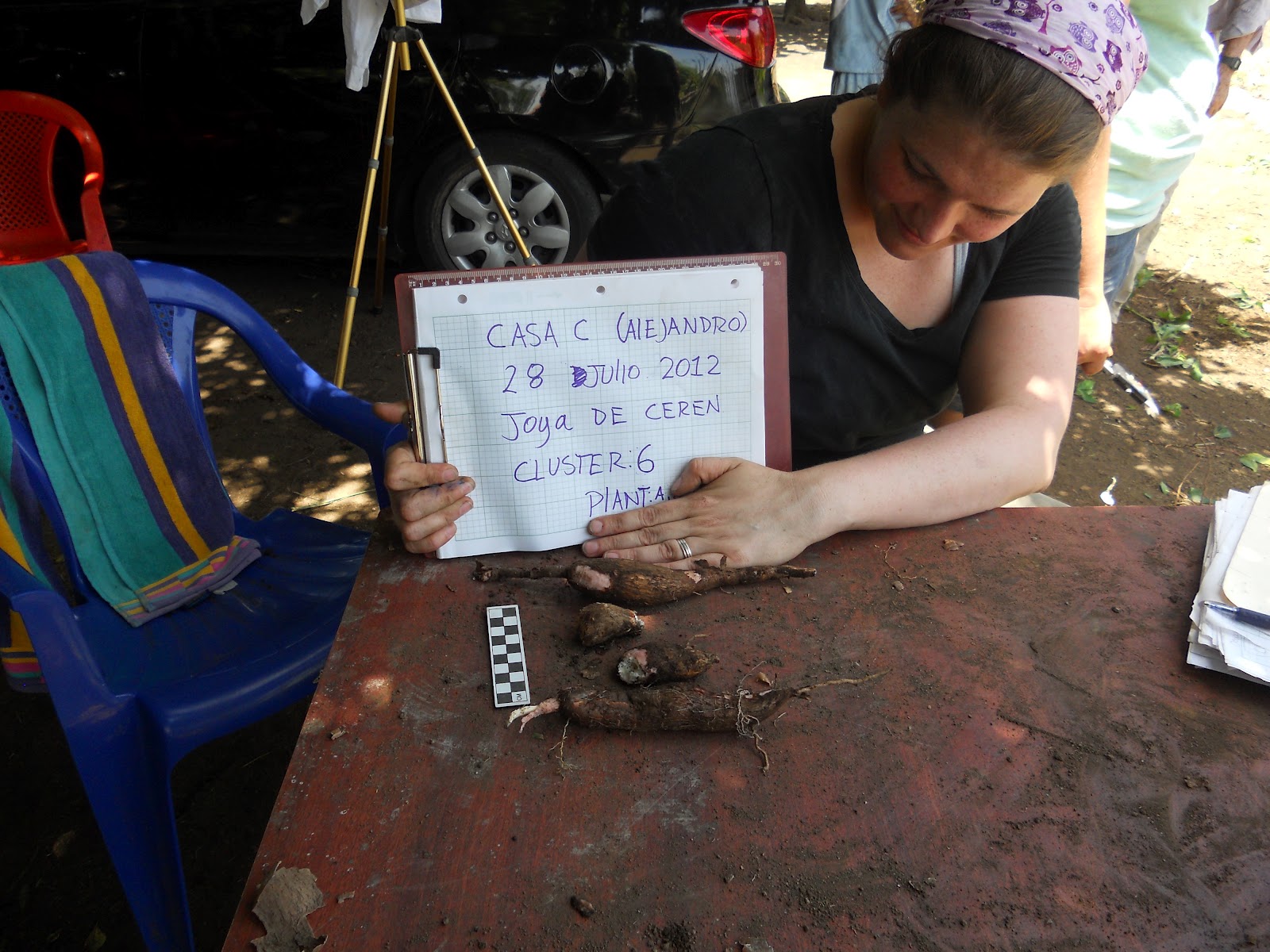
Manioc Tubers


More Manioc

Me and My Manioc

Manioc Tubers
More Giant Manioc Tubers (These look similar in size and shapes to what we found in the Classic Period)
I have been given a much better appreciation for the amount of labor that went into the harvesting of
The very surprising part of this harvest was the difficulty in getting the plants out of  the ground. On many of the stalks it took four big, strong people pulling very hard to even get these to budge. We would rock the plant side to side to try to dislodge it from the earth packed around it and then continuing pulling. This took a great deal of effort, much more so than I had previously imagined.

Struggling to harvest the manioc
Transporting the Manioc


Then as we struggled to break the tubers off the roots, Alejandro's young son came up with his machete at made very quick work of removing the tubers. While the ancient Maya did not have metal machetes, they did have sharp obsidian and flint blades. (Side note: it is very common for young children in Central American rural areas to have machetes- you get used to seeing it after a while but for those of us raised in houses where children don't get to have knives, it can be somewhat startling at first.) 
Child with Machete- he was very helpful and much better at removing tubers than we were!


While we didn't find what we set out looking for, it was important for us to recognize how much effort would likely have been put into getting the large manioc plants of the Classic Period out of the ground. In addition to the excellent drainage provided by the large beds, it is possible that the beds might have also made harvesting somewhat easier. The other variable we must contend with in our analysis is that the soils of the Classic Period and those of today are very different. The Classic Period soil was made from weathered volcanic ash (called Tierra Blanca Joven soil) and was less compacted than what is available in the region today. This would have contributed to better manioc growth and likely a slightly easier harvest. 

Delicious sugary manioc dish
Manioc Plant Left-overs (Post-Harvest Pile). If you look closely you'll see a goat having a manioc-leaf snack! 
Finally, one other area of cultural interest was the way in which Alejandro's wife fed us throughout the day. We would be in the middle of measuring tubers and she'd be there asking if I wanted her to make a chicken soup. In the end, she fed us more yucca (manioc) than we could possibly eat and proudly presented each of us with a glass of Coca Cola. I will never stop being impressed by the hospitality I find in Joya de Ceren.

Thursday, July 26, 2012

Fun Day Trip: La Puerta del Diablo and Panchimalco

To break up the days of official meetings, talking with people about our future research, and of course manioc harvesting, we took a day trip to La Puerta del Diablo and the nearby town of...   As we chugged along in our little car climbing the mountain to get to La Puerta del Diablo, we all commented on a two things in particular-

1. The road of El Salvador are amazing! I wish that Seattle would come talk to the city planner of El Salvador because the roads here are amazing. There are many cars on the road and lots of traffic but with a series of round-abouts and a commitment to keeping the roads maintained it is honestly so much better to drive around here than in Seattle!  Now you will see so many things you'd never see in the States when it comes to driving- for example if there is room on the road, then it is considered a lane, if you can hold on while it is moving then you are welcome to ride on top of a semi-truck, in the bed of a pick-up holding  a bar (taxis here but we refer to these as 'death traps' given if they roll you are likely to not survive) , and a family of five or six riding on a motorcycle or scooter. You are less likely to see car-seats for children (I never have here in the Joya de Ceren area)...and during rush hour the buses can be packed so full that the back of the bus has people riding standing on the bumper and holding onto the roof.  I'll try to get some vehicle pictures for you so that you'll believe me! Oh and when driving here but sure to keep your eyes open for people running across the freeways. It is a common practice and somewhat startling to those more familiar to U.S. driving.
Not even a main highway- but none-the-less a beautifully paved road!
2. The beautiful views and amazing countryside are not what people generally think of when we tell them about El Salvador. As you read in my earlier post, I was warned often while in Guatemala to look out for Salvadorans and be very careful.  In my experience, El Salvador is just as safe as Guatemala and other regions of Central America. It is common when I tell people in the U.S. that my fieldwork is in El Salvador to be met with worried looks and questions about my safety.Sometimes the view of El Salvador and Salvadorans is far from accurate. Much of this is colored by the 20+ year long civil war or the horror stories of nuns or Archbishop Romero having been killed here.   But in reality, El Salvador is a  beautiful place and I have always been touched by the friendliness and helpfulness of the people I've met here.  This doesn't mean it is without danger (there is no place without danger and big cities always carry their own type of dangers).  There are bus robberies, gang activities, high rates of poverty and joblessness, and a system of justice is one where you are guilty until proven innocent! So, while not without dangers it is interesting to see the perception of danger by outsiders.

Us Climbing La Puerta del Diablo
Okay, so more about our trip. We arrived at the top of the mountain and pulled into the area at the base of La Puerta del Diablo. Many people were visiting and climbing the various parts of the rock formation. Stairs have been put in and visitors take many photos of the amazing panoramic views of El Salvador. (For you archaeologists out there: As we passed an area where people had thrown trash in a cave Payson was sure to point out that we were watching the formation process of a midden!)  We climbed up to a cave area overlooking the valley and snapped few photos of course!
La Puerta del Diablo

After our trip to La Puerta del Diablo we descended the mountain to the town of Panchimalco. This is a colonial style town. Check out the pictures of the town and church. There were multiple church services in place and prayer groups were meeting in the Catholic Church when we stopped by for a brief visit. We left just in time to escape a major down pour- it is the rainy season here after all!

Turned out to be a fun visit! 
Panchimalco as seen from La Puerta del Diablo

A Street in Panchimalco
The Catholic Church in Panchimalco
Down-pour in Panchimalco (Hello Rainy Season)


Manioc Harvest Day 2: Not what we expected

Our second day of manioc harvesting was not exactly what we expected. We had planted our second test plot on the land of a friend of ours, Oswaldo.  A few days before our harvest there, we visited to confirm the date of our harvest and to catch up. This proves to be a useful way of distinguishing a social visit from when we are actually working.  Without this initial visit we'd likely get nothing done on harvest day due to the social obligations to visit.

Having fun catching up! From left to right: Me, Oswaldo, and Zan

As always happens here in Joya de Ceren, we were greeted with the hospitality that El Salvador is known for. Once given plastic chairs and sat on the porch, we were then offered food and finally handed elote (young corn) to eat. (side-note: I have never visited a house in Joya de Ceren or the surrounding area and not had someone rush to bring out plastic chairs for all of us.) Also, if you have not traveled through Central America, one note of caution... make sure to always have room for food. Families, especially in the 'campo' (poorer farming areas) have a very strong sense of hospitality and you are always offered food when visiting. It would also be very rude to refuse the food, so best to leave a bit of room for whatever food you might be given!  This is part of the network or reciprocity here- where a guest in someone's house is always treated well and provided for. Upon completing our harvest Day 1 with the Garcia family we were given a wonderful hibiscus drink (and just had to suck it up and hope the water in it didn't get us sick... it didn't! But as a good anthropologist and visitor you risk the sickness over insulting your hosts every time!)

Oswaldo with the manioc plants
Okay, so on to the harvest. When we returned to Oswaldo's on harvest day we were immediately surprised to see that the planting beds we established last year were not present and that all of the manioc looked small.  It turned out that something was lost in communication and Oswaldo didn't realize that the beds needed to be continually maintained throughout the year. We didn't explain this since he'd already been somewhat upset that his manioc field didn't grow very large. So, not at all what we expected, however very interesting. What this helps us see is that manioc bed built a year ago will completely disappear without maintenance. This wasn't at all what we intended to test, but one of the great things about fieldwork is that things so rarely go as planned. Thus, we had unintentionally tested what happens when beds are constructed but not maintained. The result is that the ground is very compacted and there are not the slightest signs of beds present. A very cool finding, we hadn't intended to test!

The manioc was extremely small and many plants even lacked any tubers at all. This was in very strong contrast to the manioc we harvested in field 1. We think it is likely that the very densely packed soil (compacted) resulted in very poor manioc growth. Manioc needs loose soils and not too much water for proper growth.

Stay tuned... we'll be harvesting Manioc Field 3 on Saturday and will let you know how it works out.

An image of a manioc plant without tubers and two stakes that did not grow
Oswaldo and Payson with our harvested manioc

 Not what we expected, but a great test case none the less!

Fernando Llort Museum

We visited the Fernando Llort Museum the other day and I thought I'd share a few photos with you from this trip.  The museum moved locations within the last few years. Payson and I had visited it three or four years ago and thought we'd stop by the new location and check it out. We were surprised that in this new location there were now few displayed pieces and instead an extensive gift shop!

In any event, Fernando Llort is an important cultural figure here in El Salvador.  Fernando Llort was born and raised in El Salvador and his cultural heritage is widely visible in his art. He pursued his education in Europe, but upon returning to El Salvador he established training for Salvadorans in artistic techniques and education. This has provided many Salvadorans with a vehicle for economic survival and advancement through this craft. Many of his designs have become cultural icons for the country and can be seen widely in tourist gifts produced by these artisans.

La Palma box
An Example of the gifts and artwork inspired by Fernando Llort

Fernando Llort Design
Fernando Llort


Manioc Harvest Day 1: An Organic Farmer is Born

Our first day of manioc harvest was very successful. Our first (of three) test plot was located at the house where we stay when doing fieldwork at Ceren. The family who lives there was very eager for us to see our manioc plants and expressed their surprise at how big the plants had grown in a year, especially since no chemicals were used in the growing. As often happens with our strange anthropological research, we drew a bit of a crowd of onlookers- all seemingly wondering about our strange practices (though somewhat accustomed to that by now) and as excited to see the results of our experiment.

Payson and I conducting a manioc harvest
None of us researchers had ever harvested manioc, though we'd both read about it and seen it done, but it is safe to say we are the slowest manioc harvesters on record!  Before we began the harvest we first mapped the location and spacing of each height and then we took a series of measurements including the height of any beds (surcos), the distance between rows, and the spacing of each plant along a row. After a series of individual plant photographs and measurements of soil hardness around each plant, we were ready to begin!

We had such a terrific time laughing as we struggled to uproot our manioc plant!  Once pulled from the ground, we took a photo of the roots still attached to the manioc plant, measured the height of the plant above and below the ground, as well as the diameter of the stalk.  Then, we removed our tubers and did a series of measurements on these (size and weight of each tuber).

While our real results will await calculations, upon first look we all agree those growing in the planting bed appeared larger and to have more and larger tubers than those not in a planting bed. Don Julio was so thrilled by the growth of our manioc that he said he will now replant a larger area with manioc plants and market these as Chemical-free, Organic manioc! He is waiting to hear about how our research study turns out before deciding if it is worth the effort to  build the beds. What a fun project this has been.

An organic manioc farmer is born...

Don Julio with our Manioc Plants 
Science in Action