Sunday, July 22, 2012

Background to my trip Part 2 (Continued): What we're doing here

As you read in my previous post we have found intensive manioc cultivation at the Ceren archaeological site. These manioc plants were planted in large earthen beds, which is not how manioc is currently planted by farmers in the region today.  We think the large, formal beds would have provided good drainage and probably looser soils, which manioc favors. The tuber casts we have found from the archaeological beds are seemingly larger than much of the modern-day manioc tubers grown in the region.  Hence an experiment was born...

As part of our National Science Foundation grant from last year, we set up experimental test plots of manioc. Manioc is planted by cutting the stalk into 20 cm stakes and planting these in the ground.  So in three different locations, with the help of three different farmers, we planted test areas. In each test location we planted half of the manioc plants in large beds somewhat similar to those found in the archaeological record and the other half just buried in the ground-surface.


Manioc Test Plot 1 (with proud famer Julio)
 These were planted last summer and we are here this summer to harvest the manioc plants and record their size and growth. We are collecting data to determine if these use of larger beds to grow manioc is more productive. This will help us assess why the large earthen beds might have been used by the Maya.  If this does prove a more productive way to grow crops, then our local farmers might adopt the old method of growing.

Vamos a ver!

Background to my trip: Part 2 (the summary of previous work)

 Here is a VERY brief summary of our work at Joya de Ceren to provide a little context for what we are doing here this year.  You can also go back to the beginning of this blog (from 2011) and read through my posts from the field while we were excavating at Ceren last year to get an idea of what we found and an idea of the research process. This is will just help you make sense of what we are doing this year!


Our research in El Salvador this year is based on some of our archaeological studies at Joya de Ceren in the past few years.  A little context to our research... the site I work at is called Joya de Ceren and is a Maya community that was buried by volcanic ash around A.D. 630 (Sheets 2002).  The eruption of the Loma Caldera vent (then it was just a fissure that opened in the ground surface) opened and as magma came to the surface it contact a river and resulted in layers of fine ash coating all of the surfaces present at that time.  So, the archaeological site is now buried beneath multiple meters of volcanic ash and the result is extraordinary preservation of the archaeological record. We have preserved earthen buildings, artifacts, and agricultural plants. Last field season we also encountered an earthen sacbe (road).
Earthen Ceren Sacbe (road) discovered in 2011 fieldseason
Plants and agricultural are extremely difficult to study in the archaeological record and are often limited to a few carbonized plant remains if you are very lucky and microbotanical evidence (pollen, phitoliths, etc.). At Ceren, the nature of the volcanic ash packed around plants in such a way as to preserve their impressions in the surrounding ash.  While the plants themselves have largely decomposed, their forms in the ash create a mold. Thus, as we excavate down to the Ceren horizon we encounter hollow spaces in the ash above the site (where ash layers surrounded plants during the eruption).  We fill those hollow spaces with plaster, allow it to set, and then excavate these. The result is the ability to see the plants that were being grown at this site approximately 1400 years ago.  


In 2007 we first discovered large manioc beds planted at Ceren. Manioc is a root crop that can be eaten, used to make flour, beer, or even a glue-like substance. It was suspected that the ancient Maya might have used root crops, such as manioc (Bronson 1966), however little evidence for root crops survived to the present day. Root crops do not have the same amount of pollen or microbotanical evidence that survives the archaeological record.
Me excavating the first discovered manioc beds at Ceren (2007)

no preview
Manioc Plant showing tubers that grow beneath the surface
(from: https://rauman.wikispaces.com/cassava)


When we first found this beds, we had never seen anything like them in the archaeological record. In later projects (2009 and 2011) we realized that the Ceren village was intensively farming manioc, much more so than we ever suspected.  We have yet to identify exactly how much manioc they were growing but interestingly all that we have found thus far was harvested around the same time. That is literally tons of manioc tubers that would have to be used or processed within a few days to avoid rot.
There is no way without the eruption of the Loma Caldera vent that we would ever have known that they were growing manioc or in such large quantities.  We know that maize, beans, and squash were very important in Mesoamerica and particularly the Maya area, but this research and other research on the topic of agricultural in this region, has demonstrated that those three crops were just a part of a much broader agricultural system. 


Warm Welcome But Sad News

Well we arrived in Joya de Ceren and began to catch up with our dear friends. Having spent so much time there over the years and become so close to many people in Joya, it feels a little like coming home. Our friends were glad to see us and we them.  Unfortunately, our arrival was saddened significantly as we began to catch up and learned that in addition to the one worker we already knew had died, two others had passed away.  A total of three of our workers have died since last year. This hit us all very hard as we became very close to all of these men.

One death of my dear friend Chabello we had heard about earlier in the year. His son and I are Facebook friends and this past fall he reported to me that his father had suffered a heart attack. I am still grieving his loss and it is hard to come back to Joya de Ceren knowing he won't be here to welcome us back. We are planning to go spend time with his widow and son this week, which will be tough be good.
My birthday last year with my friend Chabello
The other two workers' deaths were a total shock to us. One had killed himself by drinking poison and the other was murdered in the course of a robbery.  These are all tough to take and each of these three men are missed as project members and friends.  This worker had been only 22 years old. Last year I had driven him home after our end-of-the-year party. I had known he took a bus to come work with us each day but had no idea that he lived two hours away by bus and spent almost half of his daily salary getting back and forth from work and home (we compensated him for this once we knew!). He was 21 years old and supporting his mom, sister, and grandmother but living in a gang-ridden area. It was an experience I will never forget and so humbling to see what so many individuals live through and do for their families. Tragic and sad.

I thought it worth sharing this news with all of you. It is easy to feel like my fieldwork area will be the same each time I return, but I'm stuck every time by the dynamic changes that occur in all our lives so quickly. A year has passed and I've returned to see the babies now toddlers, the children growing quickly, and that not all of the friends I left behind a year ago are here to welcome me back.  This is life and reminds me to be ever so grateful for my days and cherish the time we have here.

The anthropologist cannot be kept separate from those they study or study along side-of and this is ever so apparent at the loss of my friends.

Saturday, July 21, 2012

Guatemala to El Salvador

Hello again.

I'm now writing from El Salvador. I finished up my language school and felt an immense amount of gratitude for the opportunity to study Spanish and particularly for the wonderful people I met while in Antigua.  Some of my fellow students really inspired me to continue following my own dreams. A wonderful British couple who are retired and sailing around the world reminded me of the many, many amazing places left to see in the world. They along with a new found Seattle friend that I manage to meet in Antigua not in Seattle helped encourage me on this path of dissertation writing. It is a long and tough road to the PhD and there are so many people who help to keep me going. I was surprised to find in a language school in Antigua some added support to keep going on my dissertation. I am ever so grateful for these friendships and inspiration.

It is amazing how much you learn and experience when you leave the comfort of your own culture and your home.  Antigua was a wonderful experience and I hope to return. I was able to go out with friends the night before I left for El Salvador and celebrate such a great experience.  Then at 4am I was picked up by a mini bus and taken to my main bus terminal in Guatemala city. When my mini bus driver learned I was headed to El Salvador he told me to be careful of Salvadorans. I told him that there are people in El Salvador that I consider my family- he was quiet after that. I am still surprised by the racism and stereotypes that exist around the world.

Anyhow, I road from Guatemala City to San Salvador on a nice bus. I left so early in the morning to make sure that I crossed the border at a decent hour and wasn't on the roads after dark. Just a little extra safety, especially as a woman traveling solo.  The only moment of slight incident was at the border when a group of men wanted us to change our money. The waited outside the passport office to surround people as they walked out. As a solo traveler I made sure to wait until someone else on my bus was ready to walk out and then quickly followed that person out so as not to be all alone in a circle of money exchangers. There was no incident but I try to be smart about my travels.

In any event, I arrived in San Salvador and met up with my advisor and one of his masters graduate students. We  have been getting our research underway so stay tuned and I'll fill you in on what we are up to and how the research goes.

Looking back at Guatemala from El Salvador 

Chris

A Blending of Religious Beliefs and Culture

A quick blog to share with you my experience visiting Santiago Atitlan's Catholic Church.
When walking through the church it is striking the evidence both for traditional Catholicism but also traditional Maya believes and religion.  The altar is by far the clearest and most direct evidence of this merging of faiths.  Throughout the new world the contact between European religions and those of Native Americans (First Nations Peoples) has resulted in complex merging of different cosmologies and world views.


Maya groups were subject to vicious attaches and abuses from the European clergy throughout the colonial period. Sacred Maya texts were burned and their authors' or practitioners' as heretics. A systemic ethnocide was undertaken throughout the Americas and the result was a great amount of suffering and cultural loss for indigenous groups. The result has been that while many indigenous groups practice the religion of the conquers (in this Catholicism), in this case the traditional ideas of Maya religions are still found interwoven throughout the Catholic church and the religious practices of its followers.

The central altar at Santiago Atitlan's Catholic Church was a deliberate attempt to recognize the integration of these religious and cultural traditions. In 1976 the altar was begun to be renovated by Diego Chavez Petzey and Nicolas Chaves Sojuel unde rthe direciton of Father Francisco Rother. The altar incorporates both traditional Catholic and Maya symbolism that was meant to show the unity of these traditions in the lives of the people of the church.  According to some at the church, the priest that succeeded Father Rother had tried to remove the Maya influence from the church but the community would not allow it.  Please enjoy the photos of this amazing blend of religious and cultural symbolism.
https://www.wingsofpeaceinternational.org/pdf/Altarpiece_Santiago_Atitlan.pdf


A trip to Lake Atitlan

Hi again,

I finally have a minute to catch you up on my trip to Lake Atitlan. The lake is actually a volcanic crater that is 10 miles across in some sections and known to be the deepest lake in Central America. Imagine what the explosion would have been like to create such a crater. Ash from this eruption has been found in places such a Florida and Ecuador!  True to life in Central America, three newer volcanoes have formed around the lake.

View of Lake Atitlan

The lake water level has change through the years. It used to be much smaller of a lake, but over the years geological events have changed the its drainage, so that it is currently much deeper than in previous years. There are a number of towns surrounding the lake, some more traditional, older towns, others now immersed firmly in the land of foreigners and tourists. There are deep and rich histories both geologically and culturally to this area, but alas only so much I can write here.  One other historical note, unfortunately in October 2005 the lake region was heavily impacted by Hurricane Stan. The major damage to the area was done by flooding and deadly landslides.


View of Lake Atitlan from San Marcos la Laguna

So on a Saturday morning at 5:30am I was picked up by a mini bus for my adventure. In true Central American style, I was originally told 6am by the man who arranged my trip and fortunately stopped back by his office the day before my trip to just make sure the trip was still a go. He said that I would actually need to be ready by 5:30am- so it was a good thing I stopped by his office! When the drive showed up I showed him my ticket and he told me the ticket was only for a tour. Fortunately having dealt with these types of incidents before, I was able to point out that my ticket clearly had transportation also included. Having a little extra Spanish helped a great deal in that regard.  So off we went on a 2.5 hour trek from Antigua to Lake Atitlan.
Lake Atitlan Map
Image From: http://gocentralamerica.about.com/od/topattractions/ig/Atitlan-Gallery/Lake-Atitlan-Map.htm

Upon arriving Panajachel we met up with our tour guide and hoped in our boat off across the lake to visit the towns of San Marcos la Laguna, Santa Clara la Laguana, San Pedro la Laguna, and finally to Santiago Atitlan. It was wonderful to see the diversity of these towns. For example San Marcos has become a New Age town where there are many yoga studios, meditation areas, and hotels for those wanting to take yoga and meditation retreats. These areas are mostly run by and used by foreigners, though some Guatemalans live and work there as well.  The towns of Santa Clara and San Pedro and Santiago were more traditional Guatemalan towns, though clearly influenced by the large tourism industry coming through Lake Atitlan. For example, in the town of Santa Clara there are huge artisan coops for textiles, paintings, and ceramic crafts.


San Marcos Meditation Pyramids


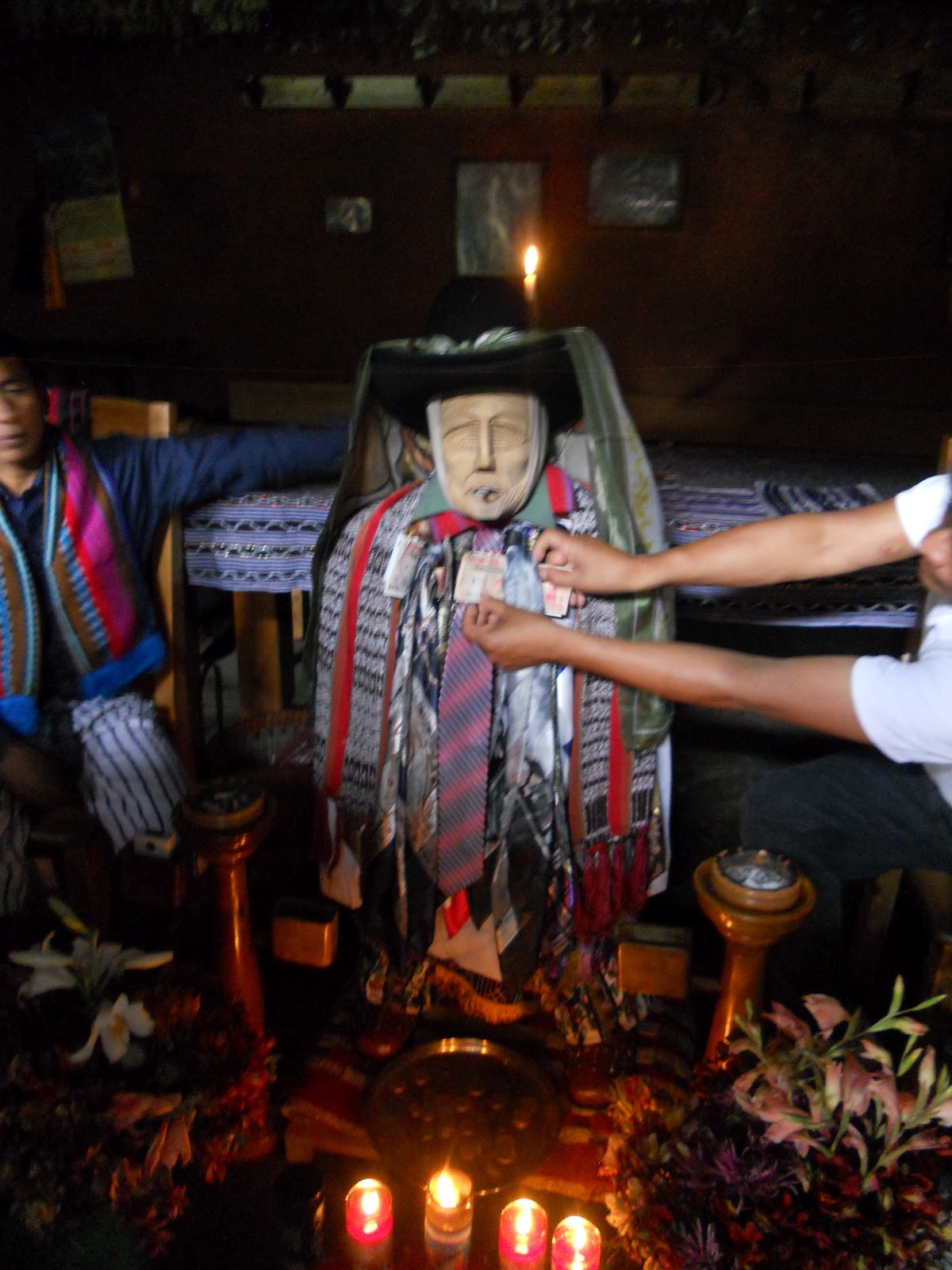
Another very interesting cultural item was going to see Maximon ("mashy-mon") (name and person in the Maya culture) and San Simon (the Christian figure) in Santiago Atitlan.  The color of the candle you get and burn for Maximon will help you with particular problem. So depending on your religious affiliation you either think of or refer to him as a saint or a ancestor that is a portal to the supernatural. Each year a new family is chosen to care for Maximon. He (his wooden stature) is attended to each day and he is given rum and continuously smokes each day. This is a wonderful example of religious syncretism, where two religious ideologies and practices have merged. The small home was filled with smoke from the chain-smoking statue and he (the statue) was also fed regular rum. This is also an example of the way in which religion and tourism can also mix. I asked various people about how they felt about bringing tourists to see a religious figure and was told that this was a way to support financially the practice of taking care of 'grandfather' as the figure is called in a local Mayan language. 


Sorry there is not time for more details on all of this! There was so many wonderful experiences in my time at Lake Atitlan.

A very interesting trip...

Chris

Tuesday, July 17, 2012

Thinking through time...language and tenses

Hi again,

There is much to update you on, including my trip to Lake Atitlan this past weekend, but that will have to wait for an Internet signal strong enough to post photos!  For now, I am reflecting on tenses and time as they relate to language.  As posted previously, the Sapir-Whorf hypothesis is often on my mind as I work my way through language school here in Antigua, Guatemala. This concept is all about if and how much language influences or determines the way in which humans think. While most anthropologists have moved far away from the linguistic determinism side of the spectrum (ling. determ. is the idea that our language absolutely determines our thoughts), there is still little doubt that our construction of language does influence the way we see the world around us.

This is very apparent to me as I've worked my way through so many tenses (times) in the Spanish language in the last couple of weeks. Most striking are the types of time or tenses that exist in Spanish that do not exist in English. As I mentioned in an earlier post, the existence of two different words for the concept "to be" in Spanish (and their uses in different instances, including those that are more or less permanent) is a different way of marking the permanence of a state of being. For example, in the case of health or feelings the way of saying this in Spanish shows the impermanence of this condition, while in English it does not.

Similarly, there are various tenses (times) that do not exist in the English language. Spanish is filled with tenses that are used to indicate if something is securely going to happen or is only an idea. Using the same verb and conjugating it in a different tense changes the meaning completely. In one instance you might indicate you will be doing something tomorrow and in another your tense choice will suggest that you hope to do it someday but it is in doubt. 

These constructions influence you to think about the nature of what you are saying in its relationship to time- not just past, present, or future, but if this is a continuous act or a specific moment in time, if this is something that is just an idea or actual did or will occur. 

Initially it just seems like a lot to remember when learning a new language, but the more I employ it the more I realize how much the structure of the language influences the way I am thinking about the world.  I 'm not asked by the English language to address how likely something is to happen when I select which tense tense to use when conjugating verbs. I might use words such as probably, likely, or will in either language, but the additional step of purposefully selecting which tense to use in Spanish has really pushed me to think differently about the issues of timing and likelihood of occurrence in a different way than I would in English. 

As I think through time and tenses, I am thinking anew about the relationship between thought and language. I am also struck that it is only in studying another language that I can see how my native language constructs time in its own way.


More soon!
Chris