Wednesday, July 11, 2012

Museo Casa de Tejido

Hi all. (this was written yesterday July 10 but not able to be posted until tonight)

I had another great day of conjugating verbs and struggling through various tenses. After the morning's adventure of having abuela (grandma of the house) beside herself with worry about why I am yet to have children, I returned to school for more work!  Luckily it was only an hour and a half more after lunch of sitting at my desk working... then we were off. My teacher and I walked over to the Museo Casa de Tejido.


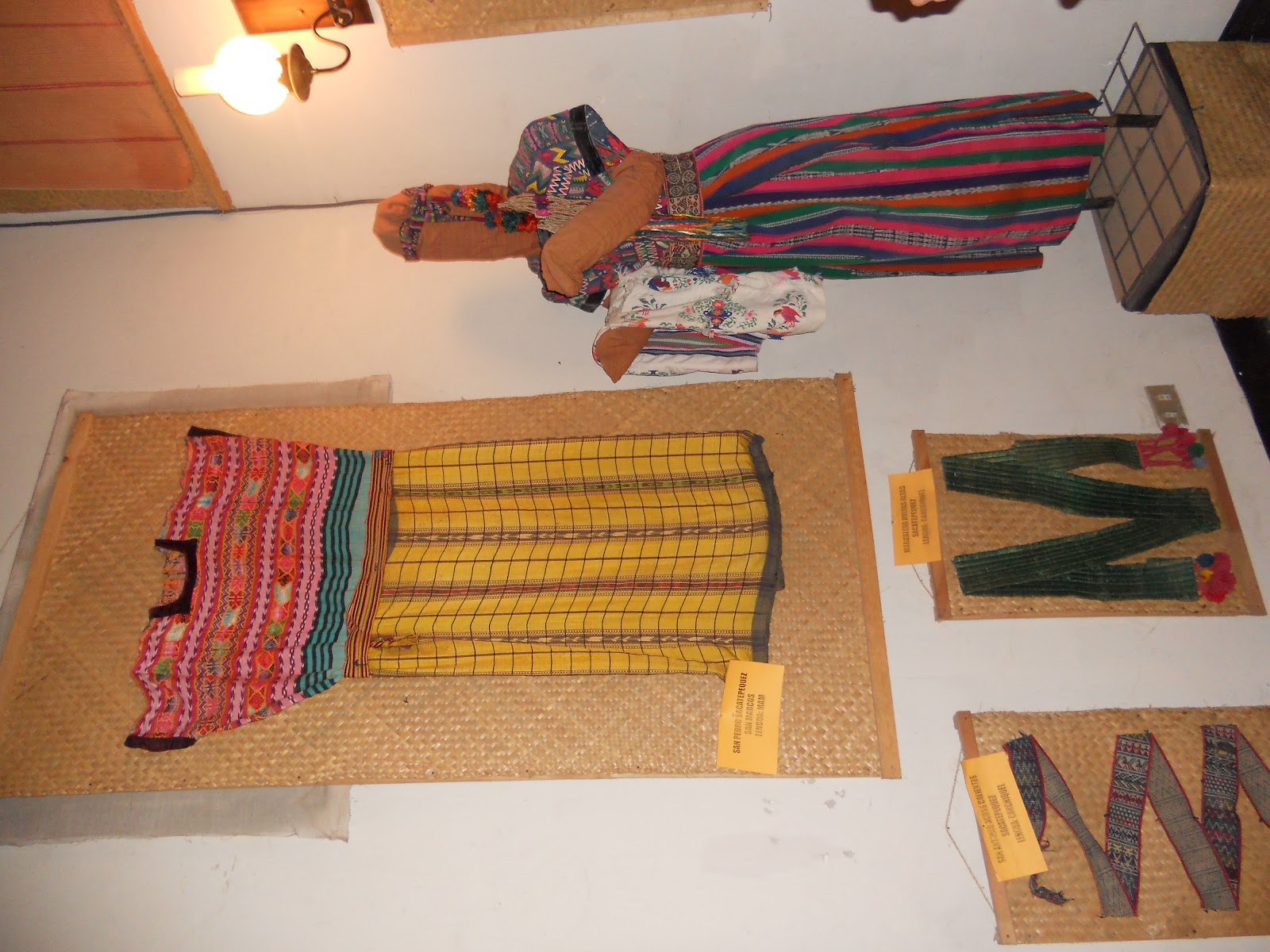
This museum is dedicated to the craft of weaving in Guatemala. There are a variety of Maya groups throughout Guatemala (approximately 22 Mayan linguistic dialects) and each community expresses their identity through a variety of designs and colors in their weaving.  We were given a private tour of the museum and I was allowed to both practice my Spanish and learn a bit about these beautiful textiles.  This woman is using a traditional back-strap loom. We spent a lot of time discussing weaving and she told me that she began learning to weave when she was 5 years old. She learned from her mother and her grandmother. We talked about how each village has their own distinctive colors and designs and that it is easy to identify (once you know all of the colors and designs that is- in other words easy for HER to identify) where a person is from by the designs and colors in their clothing. I was given a private tour of the museum and at the end was asked to put on the traditional dress from her village San Antonio Agua Caliente (see photos below for a good laugh!).  

Below you will find pictures of traditional Guatemalan huipils.  The clothing also says a lot about the climate where the group lives. A few are made of wool and lots of extra fabric for those who live at higher altitudes in the mountains, where the weather is much colder.  The garments are beautiful and a traditional huipil take approximately 4-6 months to make (if worked on for at least 5 hours a day)! Some designs are used for special ceremonies only. others are worn daily. Also, in some communities the size of the belt of the presence of a head dress signify if a woman is married or single.The traditional dress is very expensive, much more so than a pair of jeans and a t-shirt, so many of the women in these areas cannot afford to wear their own traditional dress as easily. Although, everyone was sure to explain to me that these textiles are well worth the money for many people given how much more durable they are and how much longer they last than cheap t-shirts.

Anyhow, enjoy the photos- I've got to run back to class! 
Chris 


When specifically asked to please wear the traditional dress of one of the weaver's home villages, San Antonio Agua Caliente, I had to oblige. Feel free to giggle at the tall gringa lady! :) 


Tuesday, July 10, 2012

A time to study...

Hi again all.

Well an update is in order. I'm not actually staying at a retirement home, though it seriously appeared that way when I first arrived this weekend.  All of the very old people in wheel chairs, etc. were either family members or had been staying here over the weekend while their children or gradchildren had other obligations.  Rather than a true 'retirement' home, which goes against a culture with such a strong ethos of family, this is a place where many friends or families bring a relative to stay when there are other obligation/ trips they are taking.

Anyhow, it turns out to be a great place to stay with multiple people coming and going regularly and lots of opportunities to speak Spanish. Not exactly the "traditional family" experience expected but great all the same.

School is going well. This week I have a new teacher. One practice of the school where I am studying is to change teachers each week. This way students are exposed to a variety of teaching styles and accents. Anyhow, this week my teacher is very intense and demanding. It seems impossible to learn as quickly as she would like, but she's pushing me as much as she can. She's a great teacher, but a tough one- she even wants to work with me over the weekend to make sure I progress as far as possible.

One interesting cultural aspect today... this morning the grandmother who lives in the house here asked me if I'm married and have children. I answered simply that I am married and no, I don't have children yet. She then asked how old I was and upon learning that I'm 32 (gasp) with no children, she became insistent that I must have children immediately. She asked how long I've been married and when I answered we are coming up on 4 years, she thought it even stranger I have yet to have children. I explained that upon finishing my doctorate I will begin trying to have children. Truth be told, it is even more intimidating than usual to come out to an older person here because of combined cultural and generation gap.

Anyhow, I didn't have the heart to explain the whole situation to her but laughed at how intense the pressures are for a person, particularly a woman, to get married and have children in this culture. I have seen similar types of this response throughout Central America.  I'll never forget when on one project, the doctorate student I was assisting was 28 years old at the time and unmarried, so the woman taking care of the house where we stayed insisted she needed to find a husband and then proceeded to bring by eligible bachelors whenever possible!

That's all for now. I must get back to class!

Chris

Sunday, July 8, 2012

Just roll with it! (updated)

Hi all,

Well as mentioned this morning today was the day for my switch from my hotel into living with a family. My ride showed up on time (which was impressive) and drove me over to the house since I didn't want to lug my suitcases down the beautiful cobble stone streets of Antigua!

In any event, imagine my surprise when I realized that I'm not actually staying at the traditional family home that I thought I'd be staying at. It is not totally clear (no one has said it and I don't feel comfortable asking yet) but on first glance it appeared that I'm staying in a retirement/ old folks home. :-D So it turns out that one of the elderly people is the woman who own's the house's father and she apparently has students and older people with no family live with her. Since it is Sunday there is a large gathering of family that has been coming and going all day. It is not yet clear who lives here and who does not but appears to be a mix of family, older people in need of assistance, and the occasional student/traveler. We'll see how this goes!

Life is rich and one thing about traveling / doing fieldwork is that you learn very quickly to roll with whatever comes your way. No matter what I imagine, nothing ever turns out exactly as I thought it might.  As a friend of mine was quick to point out when I updated my facebook status about my new location, I should be able to learn some great stories and as I reminded her, it is actually probably perfect for me if there are a bunch of older people here since I often have to speak Spanish with old farmers, some of whom also lack teeth!

Just thought you might appreciate the humor and richness of this adventure. Not even close to what I thought I was in for, but I'm sure it will work out for the best.

Chris

Vaction ends and the work begins.. Insight from the term To Be.

Hi again,

Well I've officially been in Antigua for one week. My Spanish has improved in this last week, but having my wife here visiting from Wednesday until this morning made it feel a bit more like vacation than work. After a teary goodbye this morning when I sent her off to the airport, it feels like the work part of fieldwork is just now beginning.  I'm home sick already- for someone who has spent so many months far from home for most of my adult life this might seem strange but I love and miss my family fiercely when I'm away.

Anyhow, in a half hour I'll be moving out of my hotel and into the home of a local family here in Antigua. I'll only admit this to you of course but I am a bit apprehensive.  Living in a stranger's home can be intimidating but I also know it will greatly aid my efforts to improve my Spanish and offers a great way to expand my understanding of others' culture.  I will keep you posted on how it goes.

Unfortunately, I'm coming down with a cold-  but somehow it is much more comforting to say "I'm sick" in Spanish than in English.  In Spanish there are two different words for "To Be" (ser and estar).  The one used to say that I'm sick implies that it is not a permanent condition. It also applies to feelings as well. So when I say in English that I'm sick or I'm sad (both a bit true at the moment), there's not indication specifically that this is just a temporary state (though it is).  In Spanish, this is more clearly defined by the form of 'to be' that I use to be only a temporary state as sickness and sadness both are!  Just another example of how the rules of the language have subtle influences on the way one might think about a situation or condition.  I'll take comfort in knowing that when I say that I'm currently sad and a bit sick these too will pass.

Chris

Friday, July 6, 2012

Quick Update

Hi all.

I have only a few minutes before class this morning but wanted to give you the brief update.  I had a wonderful birthday (thank you for the well wishes). My wife came to town and we had a terrific dinner, my family had sent me with birthday cards that made it feel a bit more like my birthday, and a fellow classmate and his son even brought me a cupcake to class for my birthday. All in all it was a good day. Though I will say after a few glasses of wine and other drinks, I found myself switching regularly from one language to the next. :)

Yesterday, I learned about midwives in my intructor´s town. He explained that there is one woman in particular who is a very gifted midwife and healer. As we talked about this process he reminded me of a saying used for giving birth ¨Dar a la luz¨... literally translates to ¨to give to the light¨. I am always struck by the beauty of this expression.  He also told me that the Guatemalan goverment has made a law saying that midwives are not allowed to deliver a woman´s first baby at home, but must be in a hospital (except in case of emergency).  He described that this law was meant to help protect women since there can be more complications during the first birth. I didn´t have time to ask much about how people responded to this law and being told where they must have their first child.

In any event, I´m off to class. We´ll see what today will hold.

Chris

Tuesday, July 3, 2012

From Storytelling, to Bilingual Thinking, to Coming Out in Spanish

Hello again,

Well here I am at the end of day 2 of Spanish school and I am completely exhausted. I had another great but long day. To give you an idea of the kinds of stories I am being told, here's how I began my day.  The first thing we did today was my instructor told me amazing stories about his village, San Antonio Agua Caliente and how it is connected to another village over 200km away via any underground natural tunnel. He told many stories about this tunnel including one about how years ago a local Maya group asked the government of the town to come to the tunnel for a ceremony. Apparently, the government granted permission but had a couple of their own people accompany the group into the tunnel. With large torches, the group entered the tunnel approximately 45km before reaching a larger clearing/opening (still in the tunnel but a large circular part of it) where the Maya group conducted a ceremony that lasted 3-4 hours.

The ceremony was apparently to give thanks to a specific deity for the good fortune that this group had recently experiences. Here Caesar pointed out that if the group did not offer thanks it was likely very poor luck would befall them.  In any event, during the ceremony they gave many offerings of food and drink (rum included) to the supernatural deity associated with that particular place. (later they drank and ate in the tunnel a large amount of food and alcohol as part of the ceremony). A very long, well told, story short, before leaving, the group left offering of precious stones (gold, silver, jade, etc.). But the local people who accompanied the group decided to return and rob those items the next day. When the would-be-robbers came to the cavern they did not find the stones anywhere but instead the clearing in the tunnel was filled with snakes. He spoke about how those offerings were not for individuals but for the supernatural and how it was so important for the group to give thanks and an offering to the supernatural to keep things in balance! It was quite a tale!

From here we moved onto discussions ranging from futbol (soccer) to the impact of the arrival of the Spanish in the New World, to current political elections, to archaeological ethics!  It is very interesting to have to express my ideas on very complex subjects using my more limited vocabulary. It forces me to think through what I'm actually try to say in a very different way and I find that I think more deeply about my ideas on a subject because of having to work hard to express complex ideas in my non-native language. It is fun, though exhausting, for my brain to think in Spanish and in English. I find myself thinking in Spanish when I'm needing to express myself or listening to someone else speaking in Spanish (in other words using it immediately) but the rest of the time my thoughts are mostly in English though sometimes in Spanish. I wonder the rate at which this change occurs. Even writing this last sentence in my mind I said "I wonder the rate at which este cambio occurs".  This is happening readily, where I will think a mostly Spanish phrase with an English word thrown in there or vis versa. It is completely unintentional and continues to happen over and over again as I write this to you. In this past sentence I just had to translate my thought out of Spanish and into English.

In any event, I apologize if my writing becomes less clear as I become more and more fatigued but want to discuss one subject that has come up time and again both in my previous experiences in Central America and on this trip. This subject has to do with my personal positionality. In short all of us have our own positionality and as anthropologists it influences how we perceive and are perceived by others. We all belong to a variety of groups, have variable experiences, and have our individuals worldview.  To spare the lecture on positionality, think of the all the ways that a particular researcher might be treated differently or might see their subject matter differently simply because of certain aspects of themselves (e.g. their gender). As one gender you  might have greater access to certain types of subject matter and not others. Okay, so when it comes to my positionality, as you by now have read I have a wife. When I say in English that I have a wife while it might catch some people off-guard if they assumed I was straight (or didn't think I look like a lesbian), it is still very clear that I mean that I (a woman) am married to another woman.  This is not at all the case in Spanish both because it is my second language and because of the construction of the language.

In Spanish, a common word for wife is esposA and a common word for husband is esposO  (I capitalized the letters so you see this is a difference of one letter- the feminine vs. masculine forms of the word).   Okay so each time I talk about my wife (side note- who by the way is at the airport right now and coming to visit me tomorrow for my birthday) (mi esposa) everyone assumes that I making a very basic Spanish mistake and not recognizing the difference between feminine and masculine forms.  What is very interesting about this is that these are people with whom in many cases I have already spoken with for some time and have successfully demonstrated my knowledge of the difference between masculine and feminine words.  Without fail, every person stops to correct this and giggles as they gingerly explain (as if to a child) how I'm not married to a woman but rather to a man.  Now, this is not at all their fault but rather illustrates their world view and the strong heteronormativity (think assumptions of straightness) of the culture. It takes some convincing, usually me saying something like "actually yes, I'm married to a woman and her name is Lauren" before they will accept this is not just an error in the feminine/masculine forms of the word.

I've tested this often by saying "My esposa..." and not following it immediately with statements about her being a woman and her name. Every single time people are convinced I am making an error and when they finally realize I'm not often say something to the effect of "No, really?" Of course I'm very used to coming out regularly in both English and Spanish but it is more difficult to come out in Spanish because of the construction of the language. Thus I find Spanish takes a little more effort than simply being about to use the term "wife" and have it understood.  That said, I have never had any truly negative experiences. While it might bother some due to religious or personal beliefs, the majority of people are seemingly curious but still kind once they realize I have a wife.

Okay my brain power is rapidly decreasing. Enjoy your 4th of July- it is after all my favorite day of the year (my birthday) !


Monday, July 2, 2012

The First Day of School

Okay, we made it through day 1 of language school (not counting my homework that I still need to complete!).

The language school I'm attending is called Fundacion Proyecto Linguistico Francisco Marroquin .  One of the reasons I selected this school was that they are the oldest Spanish school in Antigua and have a deep commitment to the preservation of Mayan languages and culture.  In addition to Spanish, they also offer total immersion programs for various Mayan languages and have been very active in projects aimed at preserving the cultural and linguistic heritage of this region.

After a brief group introduction, we were sent to work with our individual teachers. My instructor, Ceasar, is terrific. While other students were taking entrance tests, we spent the first part of the morning discussing indigenous rights, archaeology, and US, as well as Guatemalan, politics (all in Spanish of course)! Don't worry I still had to conjugate verbs, build my vocabulary, and work on different tenses all day too! Anyhow, Ceasar grew up speaking one of the Mayan languages as his native language, then Spanish, and ultimately some English. In his nearby village people still speak this Mayan language in their homes and the government has now allowed the teaching of it in schools as well. Ceasar is concerned., however, that the young people today are not interested in their cultural or linguistic heritage. He gave a few examples of this, including that many students prefer to take other languages, such as Italian, in school rather than one of the Mayan languages. He also said that he is a member of his community's traditional dance troop, but when they attempt to recruit younger members the majority of kids are not interested in traditional dancing but are interested in more 'modern' things such as break-dancing.

When we had a very small earthquake (you could barely feel it) we then discussed some of the disasters in the region that include volcanic eruptions, earthquakes, landslides, and hurricanes. He described a very serious landslide/flood that happened in 2010. He said that the village next to his was in the direct path of a major land slide and flood. People evacuated the village but many homes were destroyed. Caesar explained that what wasn't destroyed was later looted.  His village organized aid and each family contributed something to bring to the community in need. For example, one family was responsible to bring rice, another water, another beans, etc.  This is extremely important. This is the system of RECIPROCITY in action. This is the oldest and frankly the most reliable form of insurance. They helped this village in their time of need and the people will remember that and tell their children about it. If Caesar's village ever has a problem, this other community is very likely to come help in whatever way they can.

Anyhow, I am currently thinking in half Spanish and half English, so I'll end it here for now. My first day of Spanish school was exhausting but successful. 7 hours of one-on-one instruction is intense but very effective.

Off to do MY homework and to grade that of my students.

Will write again soon,
Chris